
Getting there
The ten minutes before you walk in
Nobody's first massage starts on the table. It starts in the car, in the parking lot, with a small knot of questions — how much do I take off, what if I fall asleep, what if I'm supposed to say something and I don't say it. Here is the whole thing in order, so you can stop rehearsing it.
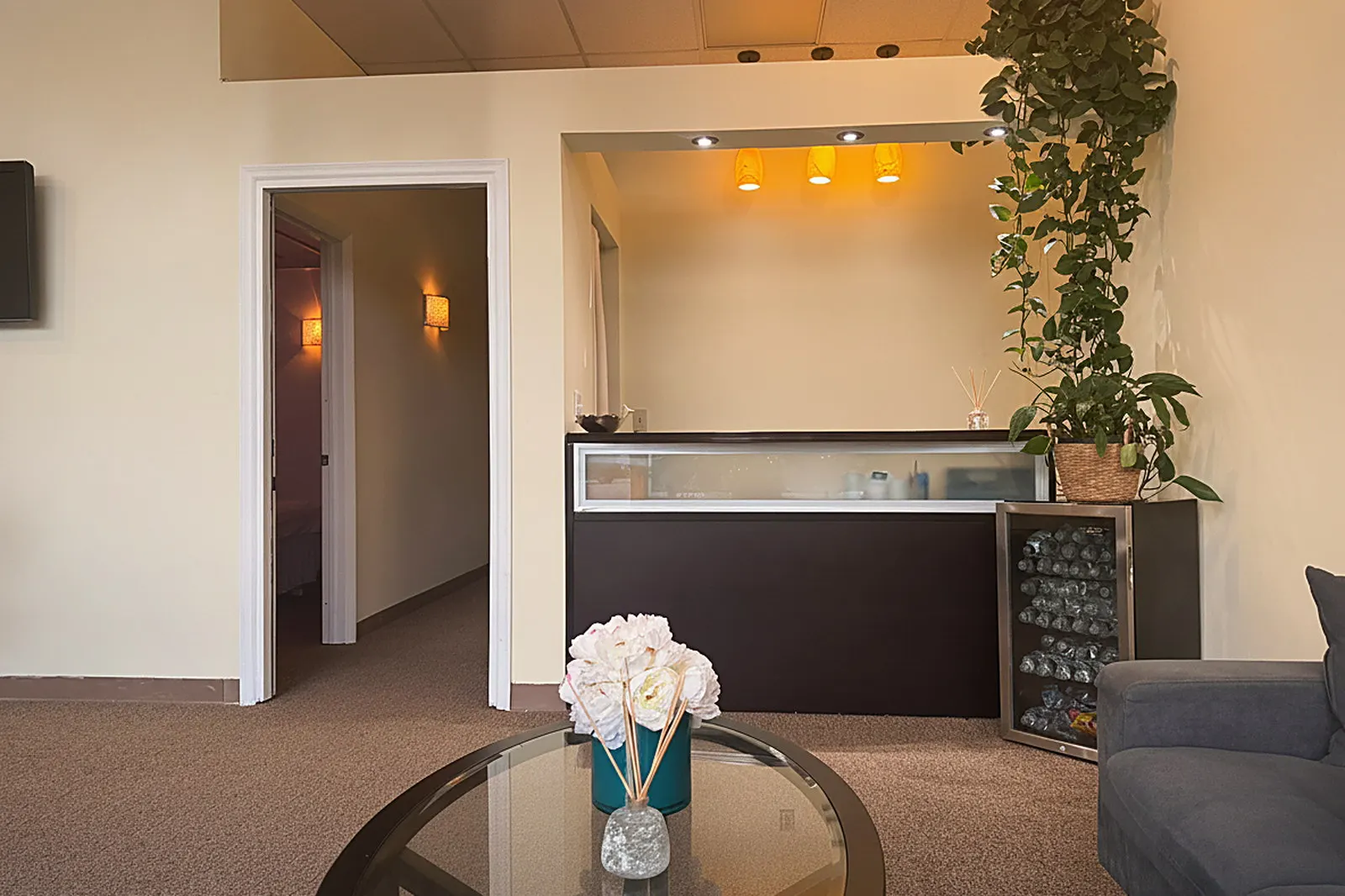
We're at 150 Pioneer Trail in Chaska Commons, at the corner of Hwy 41 and Pioneer Trail — next to Caribou Coffee, between Cub Foods and Target. Parking is a free surface lot directly in front of the door, with accessible spaces by the entrance. No ramp, no meter, no circling the block.
Eat something light an hour or so beforehand if you can. A full stomach on a face cradle isn't comfortable, and neither is arriving hungry enough that the room hears about it twenty minutes in. Skip the enormous coffee. Give yourself five to ten minutes of margin — you can book a time online or walk in and ask what's open, but the margin is what makes the first ten minutes feel calm instead of rushed.
And if you drove over the Chaska bridge from Shakopee or down 212 from Eden Prairie, sit in the car for a second before you come in. Ninety seconds of not moving does more for the session than anything else you can do beforehand.
Paperwork
The short form, and why we ask
The intake form is one page and takes about three minutes. It asks what you'd like worked on, whether anything hurts, recent injuries or surgery, whether you're pregnant, and whether you have allergies — some people react to particular oils, and that is much easier to know before than after.
It isn't a medical history, and we're not reading it as clinicians, because we aren't clinicians. What a therapist is looking for is the handful of details that change how they work: a shoulder that won't go past a certain point, a knee replacement from March, a patch of your back you'd rather nobody touched. Write those down even when they feel too small to mention. The five seconds it takes you saves the therapist ten minutes of guessing.
There are situations where the honest answer is "ask your doctor first" — a fever, a skin infection, recent surgery, a clotting disorder, a high-risk pregnancy. If that's you, check with your clinician and then tell us what they said, so we can work inside it. The NCCIH keeps a plain, non-promotional list of things to know before booking massage therapy that's worth two minutes of reading; more of the practical answers live on our FAQ page.
The awkward part
“Undress to your comfort” — what that actually means
This is the sentence everyone gets stuck on, so here's the plain version. Your therapist shows you the room, tells you which way to lie down, then leaves and closes the door behind them. You undress to whatever level you're comfortable with, get under the top sheet, and they knock before coming back in. You are never undressing in front of anyone.
For an oil massage most people leave their underwear on. Some people don't. Both are entirely ordinary and nobody at the front desk is keeping a tally. Once you're on the table you are covered by a sheet for the whole session — the therapist folds back only the arm, leg or section of back they're working on, and tucks it back before moving on. Draping isn't a courtesy we extend to nervous first-timers. It's simply how the work is done, every session, for everyone.
If undressing at all is the sticking point, book something you keep your clothes on for. A reflexology foot session is shoes and socks off and nothing else, in a recliner rather than on a table. Futon Thai work is done fully clothed on a floor mat. Plenty of people start there and move to the table on the third or fourth visit — and plenty never move at all, which is also fine.
On the table
The first five minutes
You'll usually start face-down, with your face in a padded cradle and a bolster under your ankles. If the cradle sits at a strange angle, say so straight away — it adjusts, and thirty seconds of fixing it beats fifty-five minutes of a crick in your neck.
The room is dim and warm. There's music, quiet enough to stop noticing. Your therapist warms the oil in their hands rather than pouring it cold down your back, and the first few minutes are broad and slow — long strokes along the back, some general work across the shoulders — because that's how they find out what your tissue is actually like. The specific work comes after that.
Two things worth knowing while you're lying there. You can ask for a blanket, more heat, less music, or the lights lower, and none of it is a bother. And you can ask to have an area skipped entirely — feet, scalp, abdomen, the backs of the knees. "Please don't do my feet" is a complete sentence and needs no explanation.
What happens next depends on what you booked. The full menu and prices are published, and the 60-minute oil massage covers back, shoulders, neck, arms, legs and feet at a pace that doesn't feel like a guided tour.
Speaking up
How to ask for more or less pressure without feeling rude
If we could change one thing about first visits, it would be this. People lie there enduring pressure they don't like because they don't want to seem difficult, decide afterwards that massage isn't for them, and never come back. The dial belongs to you. Here is the entire script:
- "Could you go a little lighter through the neck?"
- "That's about as deep as I want to go."
- "Can you spend longer on the left shoulder?"
- "More pressure is fine — you won't hurt me."
- "I'd rather skip my feet today."
Say it the moment you think it
Mid-stroke, without apologising, without the preamble. No therapist here reads it as criticism — their whole job is calibrating to a body they have never worked on before, and you're the only person in the room with the readout.
The rough rule: a relaxation massage should not hurt. Deep-tissue work should sit at a good ache, the kind you can breathe through evenly. If you're holding your breath, gripping the edge of the table, or quietly lifting your leg away, that's past the line — and enduring it isn't earning you a better result.
Everything else
If you fall asleep, or your stomach growls
You will not be the first. Falling asleep is closer to a compliment than a problem — people snore, people drool into the face cradle, people wake up on their back with no memory of having been turned over. It happens most days here, and the therapist simply keeps working.
Stomachs growl. Loudly, sometimes, right around the twenty-minute mark when you've finally settled. Feet are ticklish, and the fix is firmer contact, so say something and it stops. Legs are shaved or they aren't. People cry occasionally — the quiet, surprised, not-actually-sad kind — and it's usually the ones who arrived insisting they were fine. There's a box of tissues in every room for a reason.
One thing genuinely worth flagging in advance: if you're pregnant, tell us when you book. Prenatal sessions are set up side-lying with bolsters and cushions rather than face-down, and building that setup takes a couple of minutes we'd rather take before you arrive.
| Moment | What to do | What nobody minds |
|---|---|---|
| Booking | Pick 60 minutes if you're unsure — it's the standard full-body length at $80 | Choosing wrong. Your therapist adapts the work inside the session you booked. |
| Arriving | Get here five to ten minutes early for the intake form | Being a couple of minutes late. Tell us and we'll do what we can with the time. |
| Undressing | Leave on whatever you want to leave on | Draping. You're under a sheet throughout; only the area being worked on is uncovered. |
| Pressure | Say “lighter” or “a bit firmer” the second you think it | Offending anyone. It's the single most useful thing you can say all hour. |
| Falling asleep | Let it happen | Snoring, drooling, or waking up briefly confused about where you are. |
| Your body being a body | Eat something light an hour before if you can | A growling stomach, ticklish feet, unshaved legs, or unexpected tears. |
| Leaving | Sit up slowly, drink the water, don't book anything strenuous after | Feeling vague for half an hour. That part is rather the point. |
Afterwards
How you'll feel walking out
Slow. Pleasantly stupid for about twenty minutes — that's the phrase most people land on, unprompted, at the desk. Your therapist will tell you to take your time and they mean it: sit up on the edge of the table, wait for the room to settle, then get dressed. Standing up fast is the only reliable way to feel bad after a massage.
There's water at the desk. Take it. Some people walk out loose and light immediately; others feel almost nothing until the next morning, when they notice they've turned their head further than they have in a month. Neither one tells you whether the session worked.
If you're curious what the practice is generally understood to do, the AMTA — the trade body whose membership the City of Chaska requires of every therapist working here — publishes a position statement on massage and wellness. It's noticeably more restrained than most spa copy, which we'd argue is a point in its favour.
After deeper work you may be a bit tender the following day, in the way you are after starting a new kind of exercise, and it usually settles within a day or two. What to do after a massage covers the next 48 hours properly — including the one thing about water that everybody has been told and that isn't true.
Money
What it costs, and what happens at the desk
Every price is on the wall and on the website. A 30-minute oil massage is $55, an hour is $80, 90 minutes is $120, two hours is $160. Hot stone is a $10 add-on if you want it. Gratuity is not included in those numbers and it is never expected — plenty of people don't, and nothing about the next visit changes.
There's no membership, no package, and no conversation at the end of your session about a long-term plan for your body. For comparison, the nearest national chain lists around $140 for a 60-minute session if you aren't a member. Publishing the price and leaving it alone is the whole strategy.
We're open seven days a week: Mon — Sat 9:00 AM — 9:00 PM, Sunday 9:30 AM — 9:00 PM. Walk-ins are genuinely welcome — a first massage that happens because you found a free hour on a Tuesday evening counts exactly as much as one you planned a month out. Call or text (612) 600-9298 if you'd rather ask a person first. Nervous questions are the ones we answer most.
Common questions
How early should I arrive?
Five to ten minutes is plenty for a first visit — enough to fill out a short intake form and tell your therapist what's going on. If you've been in before, arriving right on time is fine.
Do I have to undress?
Only as far as you're comfortable. For oil massage most people undress to their underwear; you're under a sheet the whole time and the therapist only uncovers the area being worked on. For futon (Thai) massage and reflexology you stay fully clothed.
What if the pressure is too much — or not enough?
Say so, right away, mid-stroke if you need to. A relaxation massage should never be painful, and deep work should never be more than a manageable ache. You set the dial, not us — and no therapist here will take it as a complaint.
Am I supposed to talk during the massage?
Whatever you prefer. Plenty of guests chat, plenty go quiet within five minutes and stay that way. The only thing we genuinely need from you is a word if the pressure or the room temperature isn't right.
Do I need an appointment, or can I walk in?
Both work. Day Massage takes walk-ins whenever a therapist is free, which is a large part of why people come to us instead of an appointment-only chain. That said, evenings and weekends do fill up — if you want a specific time, a specific length, or the couples room, book ahead online or call (612) 600-9298.
Is gratuity included?
Gratuity is not included in the listed prices. It's appreciated but entirely up to you, and it's never expected.
What if I don't know which massage to book for my first visit?
Book the 60-minute oil massage ($80) and tell your therapist at the start what's been bothering you. It's the standard full-body session, and the same booking can be worked light and flowing or slow and deep — you don't have to decide which before you arrive.
Sources & further reading
Massage is one of the oldest forms of self-care, and what we do is squarely on the relaxation side of it. We make no medical claims — for neutral, non-promotional background, read the NCCIH on massage therapy , what the science actually says , relaxation techniques and the AMTA on massage and wellness .
Those are general educational references about the practice, not statements about any particular session here.
Day Massage is a relaxation and wellness studio, not a medical provider. This article is general information, not medical advice.