
The setup
Two tables, one room, two therapists
A couples massage is not a special technique. It is a room. Two tables set side by side, two therapists starting at the same moment, one door. Everything that happens on your table is the same oil massage you would get on your own — the only difference is that there is a second person four feet away having it at the same time.
Here it runs $160 for 60 minutes and $240 for 90, for both people together, gratuity not included. There is one couples room, which is the single most important operational fact on this page: it is the one service we ask you not to walk in for. Times, what to expect and the booking link all sit on the couples massage page.
Say the premise out loud and it sounds redundant. Two people could simply book two appointments. They could — and most don't, and the reason is worth unpacking, because it turns out not to be about the massage at all.
The argument that lands
“We never do anything together that isn't logistics”
That is close to a direct quote, and we hear some version of it constantly at the front desk.
Couples who have been together a while share a calendar, a mortgage, a pickup rota and a long-running disagreement about the garage door. The conversations are all operational. Even dinner out has a tendency to become a status meeting with candles. What a couples booking removes is exactly that: for 60 minutes neither of you is managing anything, and there is nothing to discuss because there is nothing to decide.
It is also low-friction, which matters more than it should when two schedules have to agree. Chanhassen is about ten minutes away, Shakopee about eleven over the Chaska Bridge, the parking is free and directly in front of the door, and the last sessions of the day start late enough that you can come after the kids are down. The NCCIH's page on everyday stress makes the same unromantic point in general terms: the interventions that help are the ones you actually manage to schedule.
Honest account
What the room actually feels like
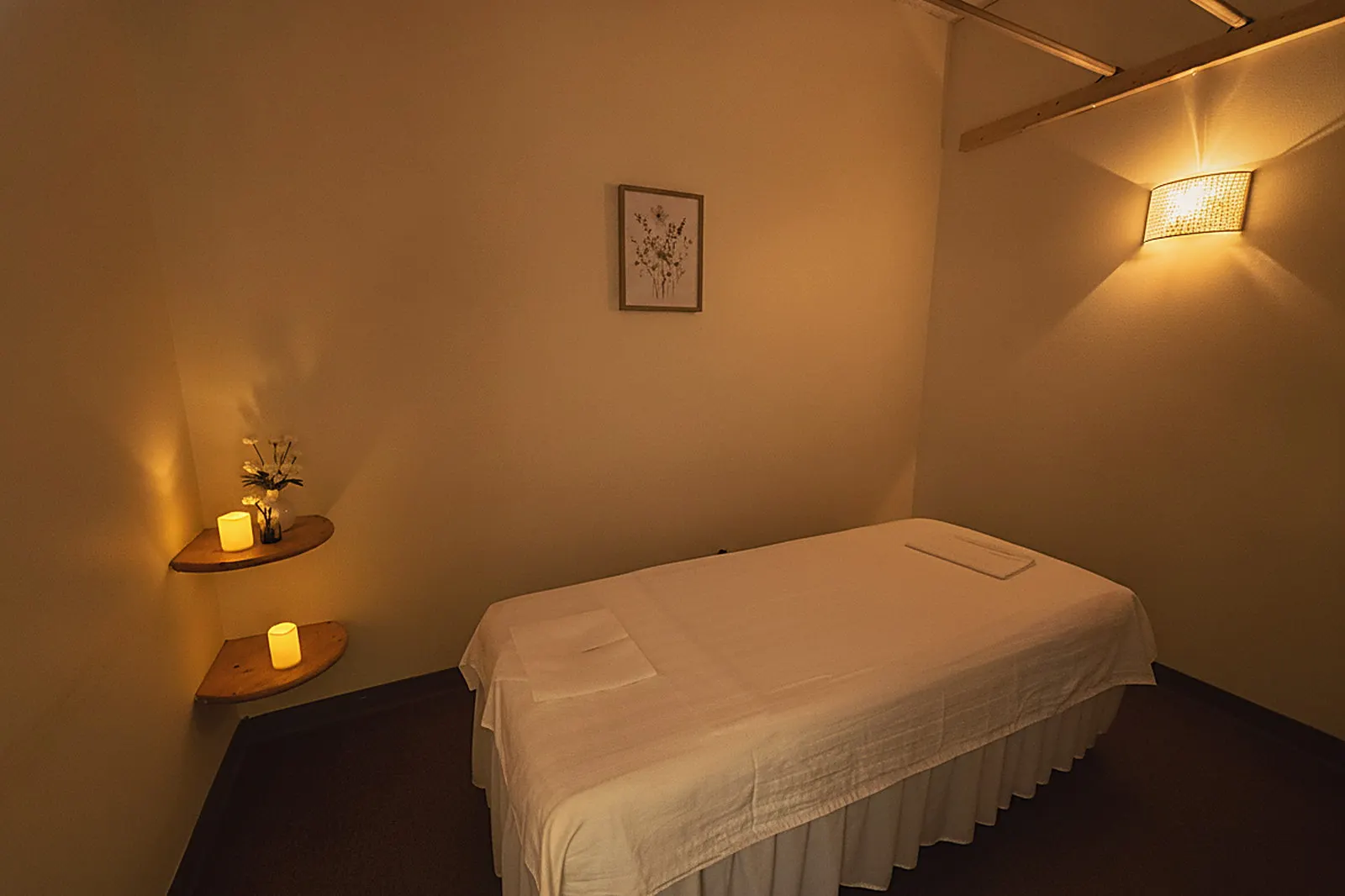
Nobody describes this part honestly, so: the lights are low, the two tables are close enough that you could reach across, and your therapists begin within a few seconds of each other and then get on with their own work. They are not synchronised. Nothing is choreographed. After about two minutes you stop registering the other table at all, which is rather the point.
You can talk or not. Most pairs talk for the first five minutes, then one of them stops answering and that settles it — face down in a cradle you are looking at the floor anyway, so conversation tends to die of natural causes. Neither therapist has an opinion about which way it goes.
The practical details are the same as any oil massage. Undress as far as you are comfortable, you are under a sheet the whole time, and only the area being worked is uncovered. Pressure is set per person: one of you can be getting firm deep-tissue work while the other has something much lighter, at the same time, in the same room. If neither of you has done this before, the first-visit guide covers the rest.
One genuine caveat, and it is the only way a couples booking goes wrong: if one of you wants to chat the whole hour and the other wants silence, sort that out in the car.
When people book it
The occasions, in rough order of frequency
This is what the calendar actually looks like, over a year.
- Anniversaries. The most common reason by a distance, and the easiest to plan around.
- Birthdays for the person who is impossible to shop for — the one who already bought whatever they wanted in March.
- The week of a wedding. Sometimes the couple; more often the bride and her mother, or two of the wedding party who need an hour away from the seating chart.
- Golf weekends. Hazeltine National is 0.9 miles from the door, and one half of the pair has usually been very patient about it.
- Visiting family. Parents in town for four days, and an hour where nobody has to make conversation is a gift to everyone involved.
- The end of a hard stretch — a project shipped, a shift rota finished, a scan that came back fine.
- Valentine's Day, which is the one date we will tell you to book two weeks out. One room, one evening, a lot of requests.
- The first properly warm Saturday after a Minnesota winter has finished delivering its normal 54 inches of snow.
What is missing from that list
Nobody books a couples massage because their trapezius is tight. That is what a solo booking is for, and it is cheaper. This is an occasion service, and it is entirely fine to treat it as one.
The AMTA's position on massage and wellness stays general and stops well short of medical claims, which is the right register here. A couples massage is an occasion, not an intervention — and it does not need to be more than that to be worth $160.
The decision
Gift it, or book it together?
Two ways to buy the same hour, and they fail in completely different ways. Worth thirty seconds of thought before you commit, because one of these failure modes is very common.
| Buying it as a gift | Booking it together | |
|---|---|---|
| How it works | A gift card in any amount, from the front desk or over the phone. They choose the date later. | You pick the slot for both people, online or by phone, and it is settled. |
| Best for | Birthdays, holidays, and anyone who never books anything for themselves. | Anniversaries and anything that already has a date attached to it. |
| How it goes wrong | It sits in a drawer. A gift card with no date on it is a very slow gift. | You leave it late and the one couples room is already taken on the Saturday you wanted. |
| The fix | Hand it over with a date already circled — or book the slot yourself and put the confirmation inside the card. | Book a few days out. For Valentine's Day and Mother's Day, a couple of weeks. |
| Cost | Any amount. A 60-minute couples session is $160. | $160 for 60 minutes, $240 for 90. Gratuity is not included. |
Gift cards can be put toward any service on the menu, not only the couples room.
The version that actually works
Buy the card, then book the appointment yourself and write the date inside the card. It removes the only real failure mode and converts a gift into a plan, which is the harder half of the present anyway. Gift cards are available at the desk or over the phone in any amount.
Not only partners
It doesn't have to be a partner
The name does more harm than good. A couples massage is two people in one room at the same time. The relationship is nobody's business, and the front desk will not ask.
We have had sisters, a mother and her adult daughter the week before a wedding, two friends who have known each other since Chaska High School, a father and son before a round at Hazeltine, and two coworkers spending a long lunch pointedly not talking about work. All of it is the same booking at the same price.
If you have been considering it for a friend and hesitating over the word, book it. It is the least awkward version of a shared hour there is, precisely because you spend most of it face down and silent.
Practical
How to actually book it
One room, so this is the service to plan rather than improvise. Book online, or call or text (612) 600-9298 — texting works and is the fastest way to ask whether a particular Saturday evening is still open.
We are open Monday to Saturday 9 AM to 9 PM and Sunday 9:30 AM to 9 PM, at 150 Pioneer Trail in Chaska Commons, at Hwy 41 and Pioneer Trail — next to Caribou Coffee, between Cub Foods and Target. Parking is free and directly in front of the door. Arrive five to ten minutes early if it is a first visit for either of you; there is a short form.
And if the 90-minute version is within reach, take it. The extra half hour is where both of you stop thinking, and $240 for that is a fair trade.
Common questions
How does a couples massage work?
Two tables in one room, two therapists working at the same time, so you and your partner are side by side for the whole session. It's $160 for 60 minutes or $240 for 90. The couples room is a single room — please book ahead rather than walking in for this one.
Does a couples massage have to be with a partner?
Not at all. Friends, siblings, a parent and an adult child, or two coworkers on a lunch break all book it. It's simply two people in the same room at the same time.
Do both people have to book the same service and the same length?
The couples room is booked as a single session, so it is the same length for both of you — 60 minutes at $160 or 90 at $240. Pressure and style are set individually, so one of you can have firm work while the other has something light. If you want two genuinely different services, call (612) 600-9298 and we will see whether we can start you at the same time in separate rooms.
Am I supposed to talk during the massage?
Whatever you prefer. Plenty of guests chat, plenty go quiet within five minutes and stay that way. The only thing we genuinely need from you is a word if the pressure or the room temperature isn't right.
Do you sell gift cards?
Yes. Order one online through our Square gift-card page, or stop in or call (612) 600-9298 and we'll sort one out — you can put it toward any service on the menu.
How do I book an appointment?
Three ways: book online through our scheduling page, call (612) 600-9298, or walk in. Online booking shows live availability, so it's the fastest way to see what's open tonight.
Sources & further reading
Massage is one of the oldest forms of self-care, and what we do is squarely on the relaxation side of it. We make no medical claims — for neutral, non-promotional background, read the NCCIH on massage therapy , what the science actually says , relaxation techniques and the AMTA on massage and wellness .
Those are general educational references about the practice, not statements about any particular session here.
Day Massage is a relaxation and wellness studio, not a medical provider. This article is general information, not medical advice.